
Roofers and roofing contractors
Roofing is the trade where the cold caller is most likely to knock. Here is what each type of roof job involves, when building regulations step in, and the checks to make before anyone goes up a ladder.
On this page
Want a price for your project?
Tell us what you need. We reply by email within 1 working day. Free, and nothing is shared without asking you.
In numbers
- less than 25%Roof re-covering without a building control application (England): share of envelopePlanning Portal guidance, read 12 October 2026. Planning Portal
- less than 50%Roof re-covering without a building control application (England): share of roofPlanning Portal guidance, read 12 October 2026. Planning Portal
- 15% or moreIncrease in covering weight that needs approval (England)Planning Portal guidance, read 12 October 2026. Planning Portal
- 25%Roof area repaired or re-covered before insulation is normally improved (Wales)Welsh Government guidance, read 12 October 2026. Welsh Government
- Listed as needing a warrantChanging roofs: building warrant needed (Scotland)mygov.scot, read 12 October 2026. mygov.scot
- 5% (1.4 million)Dwellings with a damp problem (England)2024, published 29 January 2026. GOV.UK (MHCLG)
- 42%Dwellings with a loft that have over 200mm of loft insulation (England)English Housing Survey 2024 to 2025, published 29 January 2026. GOV.UK (MHCLG)
- 25%Largest deposit Citizens Advice advises agreeing toread 12 October 2026. Citizens Advice
- 14 daysTime to cancel a contract if you change your mind (where it applies)read 12 October 2026. Citizens Advice
- 2021 (2023 amendments) and 2026Editions of Approved Document L (dwellings) listed on GOV.UKread 12 October 2026. GOV.UK
A good roofing job starts with a roofer who can tell you, in writing, what is wrong with your roof, what they will do about it, how long it will take and what happens if the weather turns. Roofing is not a licensed trade in the UK, so you check the firm; nobody does it for you. This page explains the main types of roof work, when building regulations come into it, and the checks that matter before you hire. Below it, you will find roofers near you.
What does a roofer actually do?
Roofing covers more than replacing tiles. The jobs people hire for fall into five groups.
Pitched roof repairs. Slipped or cracked tiles or slates, failed pointing on ridge tiles, worn lead flashings and rotten battens. A repair is usually quick, and a good roofer will tell you when a repair is enough and when it is not.
Full pitched re-roofs. The old covering comes off, the felt or membrane and battens are renewed, and a new covering goes on. This is the job where scaffolding, weather cover and building regulations all matter.
Flat roofs. Common on extensions, garages and dormers. The main finishes are EPDM rubber, GRP (fibreglass) and built-up felt or single-ply membranes. A flat roof is only as good as its detailing at the edges, upstands and outlets, so ask who will do those details.
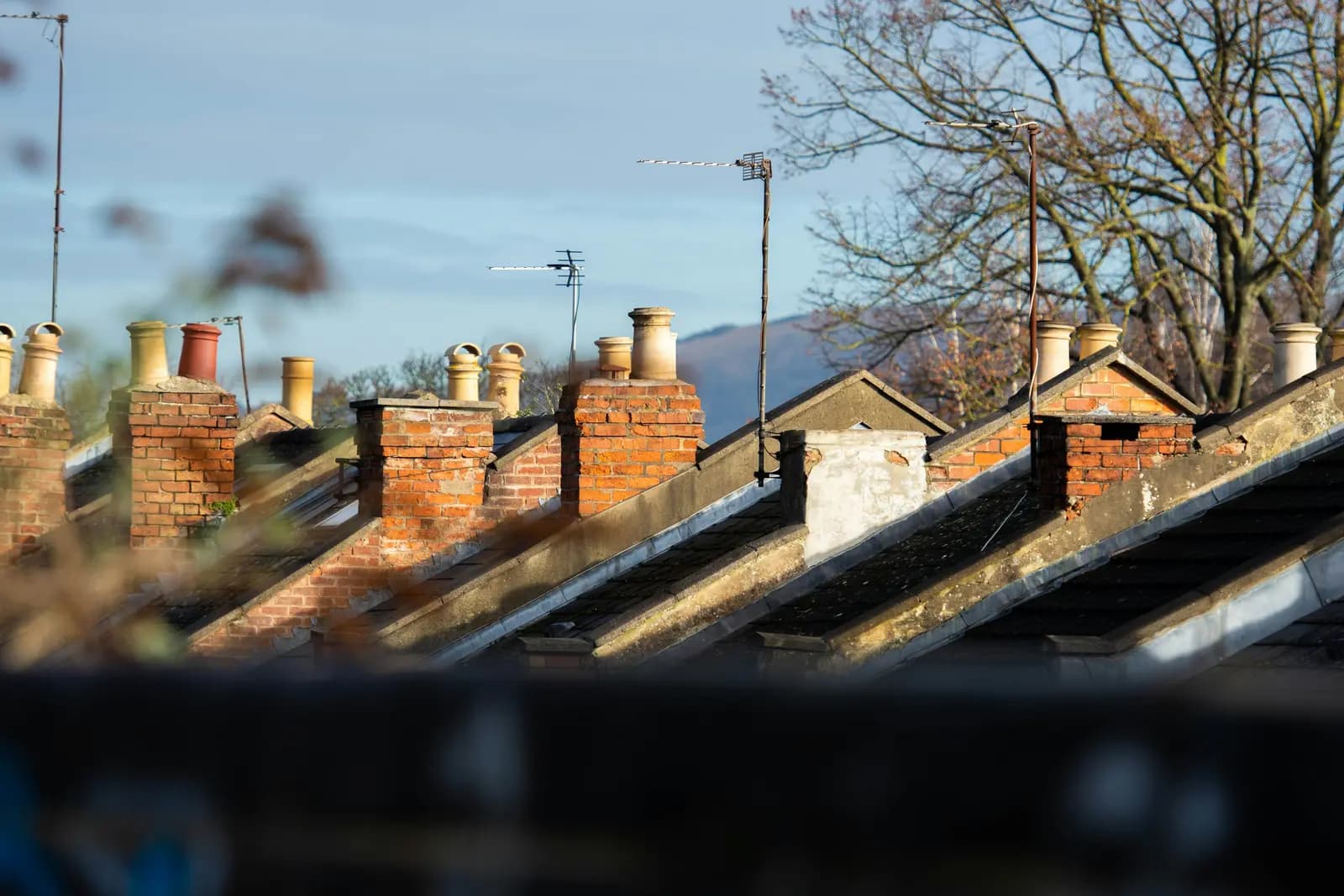
Chimney work. Repointing, rebuilding stacks, lead flashings, cowls and capping unused flues. If a chimney serves a working flue, the building regulations for flues (Part J in England) are the thing to ask about.
Fascias, soffits and guttering. Often done with a re-roof, as they are reached from the same scaffold. Check that ventilation at the eaves is kept, because a sealed roof space can start to grow condensation.
You will also meet specialists: slate and stone-tile roofers on older houses, lead workers, and firms that do only flat roofing. For an old or listed building, ask to see work on a similar property.
Why does roof condition matter?
The English Housing Survey 2024 to 2025 reports that 15% of dwellings (4.0 million) failed the Decent Homes Standard in 2024, and that 5% (1.4 million) had a damp problem (MHCLG, English Housing Survey 2024 to 2025, published 29 January 2026, read 12 October 2026). The survey does not say how much of that is down to roofs, so we will not claim a figure. It does show that damp is common enough that a leak is worth fixing before the ceiling tells you.
The same survey found about 42% of dwellings with a loft had loft insulation over 200mm thick. That matters when you re-roof, because the work can be the moment to upgrade insulation, as the next section explains.
When do building regulations apply to roof work?
In England, the Planning Portal says you will not normally need to submit a building control application to repair or re-cover a pitched or flat roof if less than 25% of the total building envelope is affected and less than 50% of the roof is affected. The envelope includes walls, floor, roof, windows and doors (Planning Portal, roof building regulations, read 12 October 2026).
Approval is needed if you go past those limits, make structural alterations, or change the covering in a way that changes its fire performance. It is also needed if a new covering increases the weight of the roof covering by 15% or more. Going past the limits can also raise the question of whether the insulation is good enough.
The energy rules for dwellings in England sit in Approved Document L. GOV.UK lists the 2021 edition incorporating 2023 amendments, and also lists a 2026 edition (GOV.UK, Approved Document L, read 12 October 2026). Which edition applies depends on the date of your application or notice, so ask your roofer or building control which one they are working to. We have not checked the thermal wording in the 2026 edition and do not state it here.
Ask the roofer one question: "Does this job need building control, and who is handling it?" A firm that has done a lot of re-roofs will answer in a sentence.
Competent person schemes
The Planning Portal advises using an installer who belongs to the relevant Competent Person Schemes. GOV.UK lists two authorised schemes for replacing roof coverings on pitched and flat roofs: CompetentRoofer, run by the National Federation of Roofing Contractors, and NAPIT (GOV.UK, competent person schemes, read 12 October 2026). A member of an authorised scheme can self-certify that the work meets the regulations instead of you making a separate building control application. Ask the roofer which scheme they belong to, look them up on the scheme's register, and ask for the certificate when the job is done.
Wales and Scotland
Wales follows a similar 25% idea. The Welsh Government says repairing or re-covering less than 25% of the area of a pitched or flat roof will not normally need an application, and that replacing or repairing more than 25% of the roof area would normally mean the roof's thermal insulation has to be improved (Welsh Government, roof, read 12 October 2026).
Scotland has building warrants instead of building regulations approval. The Scottish Government lists "changing roofs, external walls or other structural elements" among work that needs a warrant, and says it is an offence to start work without a warrant when you need one (mygov.scot, building warrant, read 12 October 2026). The page does not set out exemptions for small repairs, so ask your council's building standards team before work begins.
Do you need planning permission?
Re-covering with the same or similar materials is not normally a planning matter. Changing a roof's shape, adding dormers or rooflights, or working on a listed building or in a conservation area is different. For a loft or dormer job, see loft conversion builders and the loft conversion cost guide. Your council's planning pages are the place to confirm, and for a listed building you should speak to the council before changing the roof covering, because listed building consent may be needed.
How long does a roofing job take?
Time depends on size, weather and access, and any figure we gave would be a guess. As a rule of thumb, repairs are often a day or less, and a full re-roof is a matter of days to a couple of weeks once the scaffold is up. Ask for a start date and a duration in the quote. Ask how the roof will be covered if rain stops work with the old covering off.
What should you check before hiring a roofer?
Work through these for each roofer on your shortlist.
| Check | What to ask for |
|---|---|
| Insurance | Public liability cover and its end date. Citizens Advice says to ask to see the policy and check it will not run out before the job ends. |
| Scheme membership | The scheme's name, then look them up on that scheme's own register |
| References | Two or three recent jobs like yours, and phone the customers |
| Written quote | A fixed price with a breakdown of materials and labour, what is excluded, and whether VAT is included |
| Scaffold | Who supplies it, who is responsible for it, and whether your neighbours are affected |
| Waste | Who takes the old tiles and felt away, and whether they are a registered waste carrier |
| Guarantee | What is covered, for how long, and who stands behind it if the firm closes |
Citizens Advice says a quote is a fixed price, not a rough guess, and suggests getting written quotes from at least three traders. It also says to ask to see the trader's insurance policies and check the trader belongs to the scheme or association they claim (Citizens Advice, before you get building work done, read 12 October 2026). For general hiring steps, see how to hire a builder.
Payment
Citizens Advice says not to agree to pay everything up front, and that if a deposit is unavoidable on a long job you should keep it as low as possible and not agree to more than 25%. Always get a receipt for it. For a short repair, you may not need a deposit at all.
What are the red flags with roofers?
Roofing has more than its share of doorstep sellers. Walk away if you see these.
- Someone knocks on your door and says they have spotted a missing tile or a sagging ridge. You cannot check it from the ground, and neither can they.
- You are asked to decide today, or the price is "only good while the lorry is here".
- The quote is verbal, or only a total with no breakdown.
- You are asked to pay in cash, or for most of the money up front.
- The only contact is a mobile number, with no address and no company name.
- There is no insurance document, or they say it is "with the office".
- They offer to show you photos taken on a phone of "your" roof with no way to prove it is yours.
Citizens Advice says to ask any trader who contacts you unexpectedly for a business card or full contact details, and to ring the business to confirm it exists and that the person works there. It also says you might be able to cancel a contract within 14 days if you change your mind, counted from when you tell the trader to start work or sign a written contract. If you ask for work to begin inside those 14 days, you may have to pay for some or all of what has been done. Urgent repairs have their own rules, so read the trader's cancellation notice.
If you are worried about someone who has already called, the Citizens Advice consumer helpline passes reports to Trading Standards. If anyone makes you feel threatened, call 999.
How does MyLocalBuilders rank roofers?
Our ranked list is ordered by verified-review score over the last 12 months, then by distance. Nobody pays to move up it. A paid Featured slot sits above the list and is labelled as Featured. Our review policy explains who can leave a review, and an enquiry from you goes to one firm only. We do not check a firm's insurance or scheme membership for you, so use the table above for whichever roofer you pick.
You can search for a roofer near you or browse by city. If the roof is part of a wider job, the renovations hub may suit you better.
Roofers on MyLocalBuilders
Search by postcode
TrustMark registered building firm in Newcastle offering roofing.

TrustMark registered building firm in Birmingham offering roofing.
TrustMark registered building firm in Manchester offering roofing.

TrustMark registered building firm in Bristol offering roofing.

TrustMark registered building firm in Bristol offering roofing.

TrustMark registered building firm in London offering roofing.
Questions people ask
Do I need building regulations approval to replace my roof?
In England you will not normally need a building control application if less than 25% of the building envelope and less than 50% of the roof is affected and none of the other triggers apply. A full re-roof usually goes past those limits, so check with your roofer and your council.
Does a re-roof mean I have to upgrade the insulation?
Often, yes. In Wales the Welsh Government says replacing or repairing more than 25% of the roof area would normally mean improving the thermal insulation. In England it depends on the extent of the work and which edition of Approved Document L applies, so ask building control.
What is the difference between EPDM and GRP flat roofing?
EPDM is a rubber membrane laid in one sheet, while GRP is fibreglass laid in liquid resin and set hard. Both can last well when detailed correctly. Ask the roofer which they recommend for your roof and who will do the edges and outlets.
Is it safe to hire a roofer who knocks on my door?
We advise against it. Citizens Advice says to check any trader who contacts you unexpectedly, and a roof fault you cannot see from the ground is exactly what doorstep sellers claim to have found. Get written quotes from firms you chose.
Can I cancel a roofing contract?
Citizens Advice says you might be able to cancel within 14 days of agreeing it, but you may have to pay for work already done if you asked for it to start in that time. Read the cancellation notice you were given.
How much deposit should I pay a roofer?
Citizens Advice says not to pay everything up front and not to agree to more than 25% where a deposit is unavoidable. Short repairs may not need one. Always get a receipt.
Do roofers need a licence in the UK?
No, roofing is not a licensed trade. That is why insurance, references and membership of a scheme you can check on its own website matter.
Sources
- Planning Portal: Roof: building regulations. Read on .
- Welsh Government: Building regulations: roof. Read on .
- mygov.scot: Building warrant. Read on .
- GOV.UK (MHCLG): English Housing Survey 2024 to 2025: headline findings on housing quality and energy efficiency. Read on .
- Citizens Advice: Before you get building work done. Read on .
- GOV.UK: Conservation of fuel and power: Approved Document L. Read on .
- GOV.UK: Competent person scheme: current schemes and how schemes are authorised. Read on .
General information, not legal or professional advice. Rules differ between England, Scotland, Wales and Northern Ireland, and each council applies them in its own way.
Ready to price your project?
Tell us what you need. We reply by email within 1 working day. Free, and nothing is shared without asking you.