
If you are looking for builders in Newcastle, the housing is the place to start. The city has a very different mix from most English cities: a large share of flats and tenements, plenty of terraces, and a big block of semi-detached homes. The right builder for a Jesmond terrace is not automatically the right one for an interwar semi in Fenham or a flat conversion in Heaton, so it pays to know which kind of job yours is before you ask for quotes.
This page covers Newcastle City Council's area. Gateshead (across the Tyne) and North Tyneside are separate councils with their own planning and building control teams, even though they feel like one conurbation.
What is Newcastle's housing like, and what does it mean for builders?
In the 2021 Census, 122,798 households lived in Newcastle upon Tyne. The largest group, 42,492 or about 35%, lived in a semi-detached house. Next came purpose-built blocks of flats or tenements at 30,478 households (about 25%), then terraced houses at 28,946 (about 24%). A further 7,364 households, around 6%, lived in part of a converted or shared house, and 11,676 lived in detached houses (Office for National Statistics, Census 2021, table TS044).
Compare that with Bristol, where terraces are the biggest single type. In Newcastle, the many flats change the legal ground rules for building work, and the semis create a steady demand for rear and side extensions.
The age of the stock helps too. The Valuation Office Agency's Council Tax figures for 31 March 2025 count 140,770 dwellings in the city. Of those, 17,000 were built before 1900 and 9,110 between 1900 and 1918, so around 19% pre-date 1919. A bigger chunk, 24,810 or about 18%, dates from the 1930s. That is the era of the interwar semi, which often suits a loft conversion and a rear extension.
Tyneside flats, terraces and semis
Newcastle's older streets are full of the Tyneside flat: a terrace that looks like a row of houses but is divided into two self-contained flats, one up and one down, each with its own front door. If you own one, a few things make building work different.
- Ownership of the roof space. Whether the upper flat owns the loft is a question for your title and lease, not for the builder. Check before you plan a conversion.
- Planning rights. GOV.UK's householder guidance says permitted development rights do not apply to flats, so most external changes, including dormers and rear extensions, need a planning application.
- Shared structure and neighbours. With two households under one roof as well as neighbours on either side, work often triggers the Party Wall etc. Act 1996 and needs careful sequencing.
Terraced houses in areas like Jesmond, Heaton and Gosforth have their own pattern. Many are Victorian or Edwardian brick houses with a narrow back extension, and they suit rear dormer loft conversions and kitchen extensions. Interwar and postwar semis generally have more freedom to extend, and the usual jobs are side-and-rear extensions, garage conversions and loft rooms.
Typical jobs for builders in Newcastle
Extensions. A single-storey rear or side extension is the most common house project. For houses, GOV.UK's guidance gives a rear limit of 3 metres beyond the original rear wall (4 metres if detached) under permitted development, outside designated land, with larger limits available through a neighbour consultation scheme. Our guide to house extension costs shows what published sources say about price. You can also browse extension builders in Newcastle in the directory.
Loft conversion in Newcastle. The Planning Portal says that in England a loft conversion on a house is permitted development within 40 cubic metres for terraced houses and 50 cubic metres otherwise, including any earlier roof enlargement. That does not cover flats or conservation areas. A dormer or hip-to-gable on a semi can often be done this way, but you still need building regulations approval for structure, stairs and fire safety.
Flat and terrace refurbishment. Re-wiring, new kitchens and bathrooms, re-roofing, damp work and sound insulation between flats are typical, especially in student and rental areas.
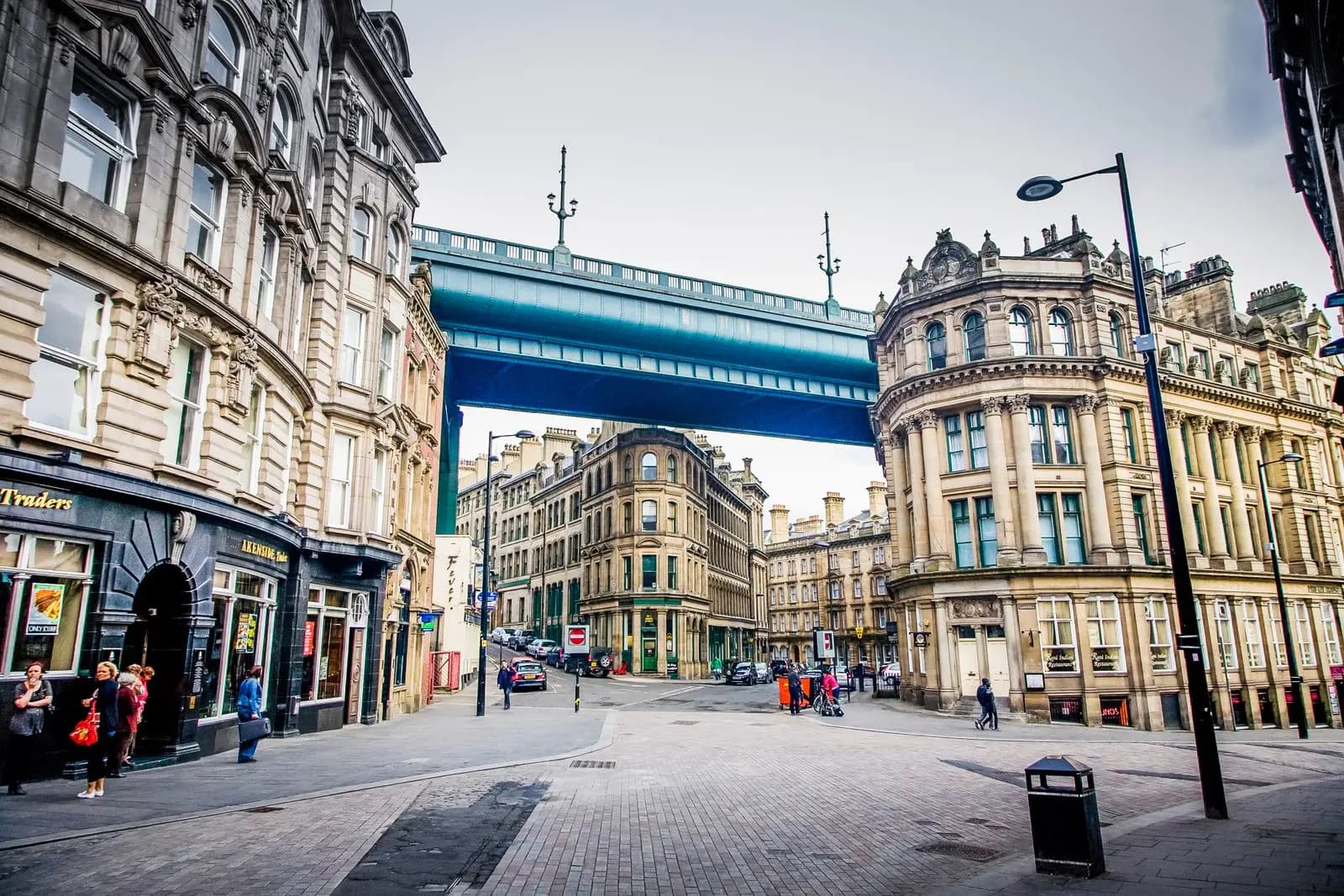
Period buildings in the centre. Grainger Town and the Quayside hold much of the city's historic building stock. If a property is listed or in a conservation area, extra controls apply, and the work calls for builders who know listed building consent and traditional materials.
Newcastle in numbers
- £207,547Average house price, Newcastle upon Tyne (all property types)July 2026. HM Land Registry
- 4.1%Annual change in average price, Newcastle upon TyneJuly 2026, year on year. HM Land Registry
- 42,492 (34.6%)Households in a semi-detached houseCensus day, 21 March 2021 (share calculated from the table's total of 122,798 households). Office for National Statistics (via Nomis)
- 30,478 (24.8%)Households in a purpose-built block of flats or tenementCensus day, 21 March 2021. Office for National Statistics (via Nomis)
- 28,946 (23.6%)Households living in a terraced houseCensus day, 21 March 2021. Office for National Statistics (via Nomis)
- 7,364 (6.0%)Households in part of a converted or shared houseCensus day, 21 March 2021. Office for National Statistics (via Nomis)
- 17,000 (12.1%)Council Tax dwellings built before 190031 March 2025 (share calculated from 140,770 dwellings; figures rounded to nearest 10). Valuation Office Agency, GOV.UK
- 9,110 (6.5%)Council Tax dwellings built 1900 to 191831 March 2025 (share calculated from 140,770 dwellings). Valuation Office Agency, GOV.UK
- 24,810 (17.6%)Council Tax dwellings built 1930 to 193931 March 2025 (share calculated from 140,770 dwellings). Valuation Office Agency, GOV.UK
- 40 m³ terraced, 50 m³ otherwiseLoft conversion volume limit under permitted development (England)Planning Portal guidance as read on 12 October 2026. Planning Portal
Conservation areas and Article 4 directions
Newcastle has a number of conservation areas, and Newcastle City Council is the place to confirm whether your street is in one. Inside a conservation area, GOV.UK's guidance says roof extensions are not permitted development, side extensions are not permitted development and only one storey can extend beyond the rear wall (the guidance was last updated in September 2019, so check current legislation).
Councils can also make Article 4 directions, which remove permitted development rights from particular streets or properties. Ask the council whether any direction covers your address before you commission drawings. A house that needs no application in one street can need one two streets away.
Planning and building control in Newcastle
Newcastle City Council decides planning applications for homes in its area. Check first whether you need permission at all, and ask the council whether it offers pre-application advice for household projects. Householder applications in England can be made online through the Planning Portal. Our guide to building regulations for home improvements explains why building control is a separate process.
Building regulations apply to most loft conversions, structural alterations and extensions, and are separate from planning. In England you can use the council's building control service or a registered private approver, and whoever you use inspects the work as it goes. Your builder should say which route they are using, and keep the completion certificate for when you sell.
GOV.UK explains both systems in plain terms:
What to check when hiring a builder in Newcastle
Building is not a licensed trade in the UK, so the checks are yours to make. Our guide on how to hire a builder covers the basics. For a job in Newcastle, also ask:
- Which type of house is it? Check that the builder has recent experience of flats, terraces or semis like yours, and ask to see photos.
- Who owns what in a Tyneside flat? Make sure the builder asks about your lease or title before pricing a loft or roof job.
- Who handles the council paperwork? Planning applications, building control and any party wall notices should be agreed in writing.
- What is in the price? Ask for a fixed written quote with items such as scaffolding, skips and making good listed separately.
- Which authority is the property in? If you are near the boundary, check it is Newcastle rather than Gateshead or North Tyneside.
- Can they show their insurance? Confirm public liability cover and any TrustMark or FMB claim on the scheme's own site.
Using this directory
MyLocalBuilders.uk helps you find local builders in Newcastle. It ranks them by verified reviews from the last 12 months, then by distance, and nobody pays to move up the list. A labelled Featured slot sits above it, and an enquiry goes to one builder only. Our Newcastle listings are still being built up, so search for a builder near you to see who is listed now.
Updated . Photo at the top: SALEH on Unsplash (Unsplash Licence).